
Home insurance by state, including the other fifty rows
Where Florida sits relative to everywhere else.
Percentage deductibles, wind credits, separate flood
Take a dwelling limit of $400,000, purely as arithmetic, and a 2 percent hurricane deductible: the first $8,000 of named-storm damage sits with the owner. A percentage of the dwelling limit, reset each 1 January instead of charged per claim, is what makes homeowners insurance in Florida a different document from the same policy sold inland.
The percentage is taken against Coverage A, the dwelling limit, never against the size of the loss. It is settled the day the policy is written and sits there all season.
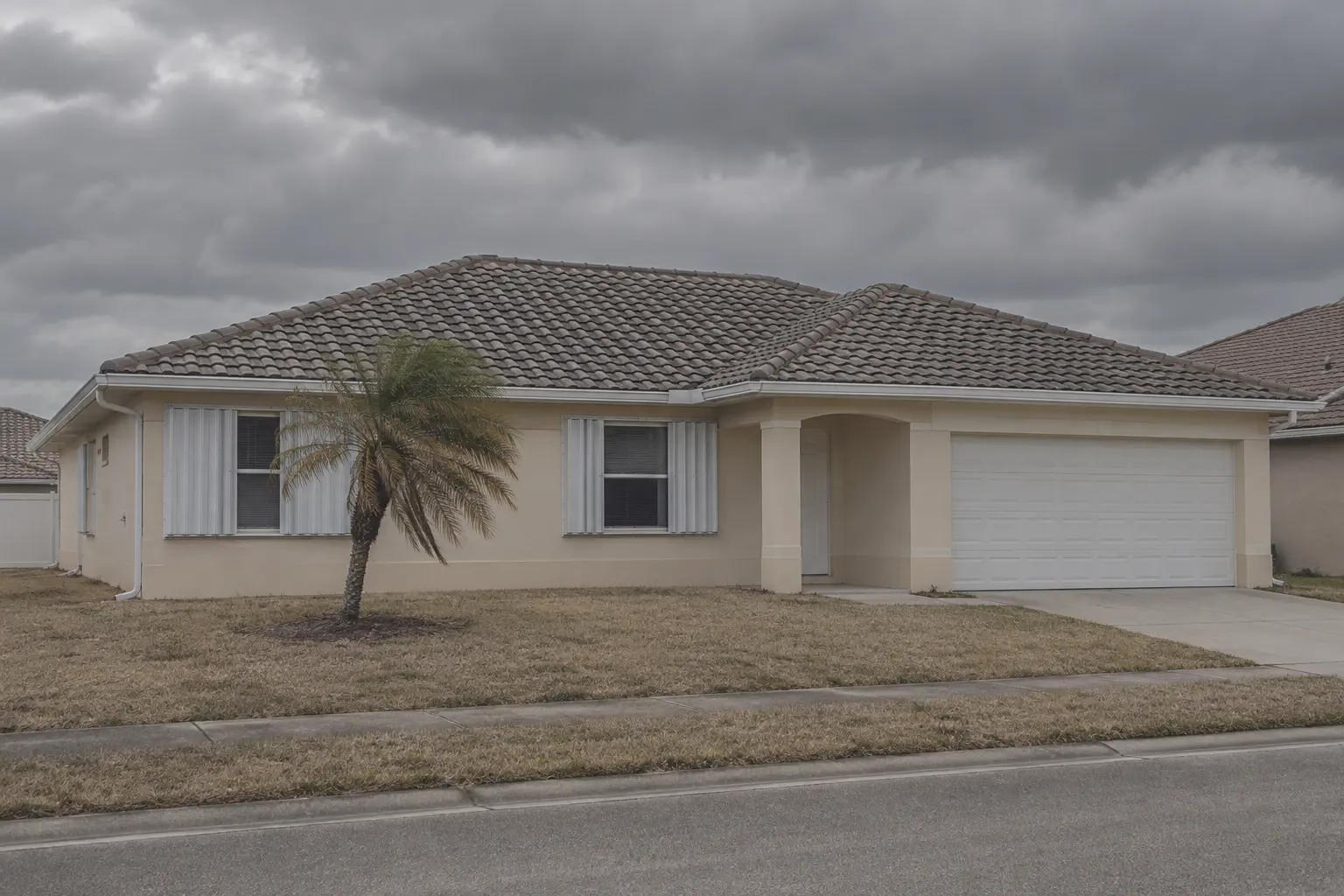
Before issuing a personal lines residential policy, a Florida insurer has to put four options in front of the applicant, under the 2026 compilation of Fla. Stat. 627.701(3).
| Option | On a $400,000 limit | Limit on the offer |
|---|---|---|
| $500 flat | $500 | Not required where dwelling limits reach $250,000 |
| 2 percent | $8,000 | 3 percent may substitute from $1 million to $3 million; none required at $3 million |
| 5 percent | $20,000 | None |
| 10 percent | $40,000 | None |
Two deductibles usually sit on the declarations page, the hurricane one and an all-other-perils one. In a hurricane only the hurricane deductible applies, as the Department of Financial Services puts it in the toolkit revised in March 2024.
The calendar year is the catch. Section 627.701(5)(a) makes the deductible annual and cumulative across covered hurricane losses, so a second storm in the same season is charged the greater of what is left of it or the all-other-perils deductible. On 1 January the count starts again, and a lower hurricane deductible newly offered mid-year waits until then to take effect.
Credits for wind resistance are not left to the market. The 2026 compilation of Fla. Stat. 627.0629(1) requires a residential rate filing to carry actuarially reasonable credits, and names seven categories without closing the list: wind uplift prevention, roof strength, roof covering performance, roof-to-wall strength, wall-to-floor-to-foundation strength, opening protection, and window, door and skylight strength. The individual features an inspector records, roof deck attachment among them, come from the uniform mitigation form rather than from the statute. Neither sets a size. No honest page can say what a hip roof is worth on a particular policy.
The evidence is one document. Section 627.711 makes the insurer state the availability and range at issuance and at every renewal, and accept the uniform mitigation verification inspection form once a qualifying inspector signs it. The form is OIR-B1-1802, adopted by Rule 69O-170.0155, valid up to five years absent material change to the structure. Its revision effective 1 April 2026 went from seven categories to nine, adding a design wind speed Region question and a Roof Slope question.
Wind credits reward a roof. A second statute decides whether the roof is insurable at all, and it turns on one number. Under the 2026 compilation of Fla. Stat. 627.7011(5)(b) an insurer may not refuse to issue or renew a homeowners policy on a structure whose roof is less than 15 years old solely because of the age of that roof. Past that line the rule changes shape rather than lapsing: subsection (5)(c) makes the insurer let the owner pay for a roof inspection before it can require replacement as a condition of coverage, and bars refusal on roof age alone once an authorized inspector reports 5 years or more of useful life remaining.
Subsection (5)(d) fixes that date and closes the obvious shortcut. Age runs from the last day on which 100 percent of the roof surface was built or replaced under the code in force at the time, or from the start of a run of partial replacements that between them reached the whole surface. A patch does not reset it: the permit for the last full replacement is what the file reads.
The separate roof deductible is a different instrument and the state caps it at the lesser of 2 percent of the Coverage A limit or 50 percent of the cost to replace the roof, under 627.701(10)(a). It reaches only claims adjusted on a replacement cost basis, and it is switched off for a total loss, for a hurricane loss, for a tree that punctures the roof deck, and for any loss needing less than half the roof repaired. Where one applies, 627.701(4)(e) puts an 18-point notice on the page behind the declarations page with no other language on it.
Age also decides whether a report is wanted before anyone quotes at all, and the one published threshold belongs to the residual market. Citizens Property Insurance Corporation requires a four-point inspection on property owner and dwelling applications for properties more than 20 years old: a Florida-licensed inspector records the age, the type and the condition of the wiring, the plumbing, the heating and cooling equipment and the roof. Roofs past 25 years in a soft covering such as shingle, or past 50 years in tile, slate, clay, concrete or metal, need documentation of at least five years of useful life remaining. Other companies set their own thresholds, and the number is a question for the call.
Everything above is a date or a document, which is what makes the call preparable. The roof date under (5)(d), not an impression of the roof. The four-point report where the house is past twenty years, not an assurance that the wiring is sound. The Coverage A limit the percentage is taken against, and the two deductibles already printed on the declarations page. An adjective offered over the phone gets converted into one of those or set aside.
Senate Bill 2-A became chapter 2022-271, Laws of Florida, on 16 December 2022. Fee shifting went first: the one-way attorney fee statute was made inapplicable to property insurance, then repealed outright by chapter 2023-15, effective 24 March 2023. Its replacement at Fla. Stat. 86.121 excludes property policies by its own terms. Post-loss benefits under a policy issued on or after 1 January 2023 cannot be signed over to a contractor, and the trigger is the issue date, not the date of the loss.
For a hurricane, tornado, windstorm or severe rain event the clock runs from landfall or from the date NOAA verifies the event, not from the day somebody noticed the ceiling stain. A leak found fourteen months later is late on the face of the statute.
Citizens Property Insurance Corporation is a state-created residual market mechanism, and the 2026 compilation of 627.351(6)(n)1 requires its rates to be actuarially sound and not competitive with the admitted market. Eligibility runs the same way: under 627.351(6)(c)5.a a private offer of comparable coverage ends it unless that offer is more than 20 percent above the corporation premium. A quote costing a fifth more still moves the risk out.
A takeout arrives as an offer packet with a date. Register no choice by that date and the policy goes to whichever participating company bid least, and a Notice of Assumption and Nonrenewal follows. The contract stays on the corporation forms until the term ends, so the paper does not change mid-year, only the name on the bill. After that term there is no way back. The count stood at 266,231 policies on 31 August 2026, against a peak near 1.41 to 1.42 million in October 2023.
Rising water. The Department of Financial Services states in its March 2024 toolkit that most homeowners policies exclude flood, and the line holds on a definition: Fla. Stat. 627.715(1)(b) makes flood an inundation of two or more acres of normally dry land, or of two or more properties one of which is yours. Water through a wind-torn roof is a homeowners claim; water that came across the street is not.
Flood is bought on its own. Florida law does not require it, a lender can, and the residual market insurer now does too, stepping the condition down by dwelling replacement cost to $400,000 on 1 January 2026 and to the rest on 1 January 2027. Thirty days is the usual wait before a new flood policy responds. Florida held 1,741,930 national flood program policies on 31 August 2026, near two-fifths of the country by our arithmetic.
Where Florida sits relative to everywhere else.
Two separate requirements, two separate policies.
The arithmetic that makes a hurricane deductible different.
The standard form the state amendments are editing.
The other Gulf state: a separate windstorm policy instead of a percentage deductible.
No. Under Fla. Stat. 627.701(5)(a), 2026 compilation, it runs annually across covered hurricane losses. A second storm is charged the greater of what remains of it or the all-other-perils deductible.
On the policy face. The 2026 compilation requires an 18-point boldface warning where a separate hurricane deductible applies, and a second notice behind the declarations page where a roof deductible applies.
The uniform state form is valid up to five years provided no material change is made to the structure. The revision effective 1 April 2026 carries nine categories; earlier forms carry seven.
One year for notice and eighteen months for a supplemental claim, under the 2026 compilation of Fla. Stat. 627.70132. For weather the clock starts at landfall or NOAA verification.
Not where it meets the statutory definition of flood: two or more acres of normally dry land, or two or more properties one of which is yours. That sits on a separate contract.
Sources and data years
Page last reviewed 2026-09-23. Each figure above carries the year of its own data.